
Every serious software company maintains a competitive analysis. It is updated quarterly, it tracks feature parity, pricing models, and market shares, and it does so with the thoroughness of a document on which careers depend.
It thus records all threats — except the one that is currently killing the industry.
The competitor that kills you is not in this analysis. They don't sell anything in your segment, they don't undercut your price, they don't poach your staff. They are on your customer list. They are still paying licensing fees.
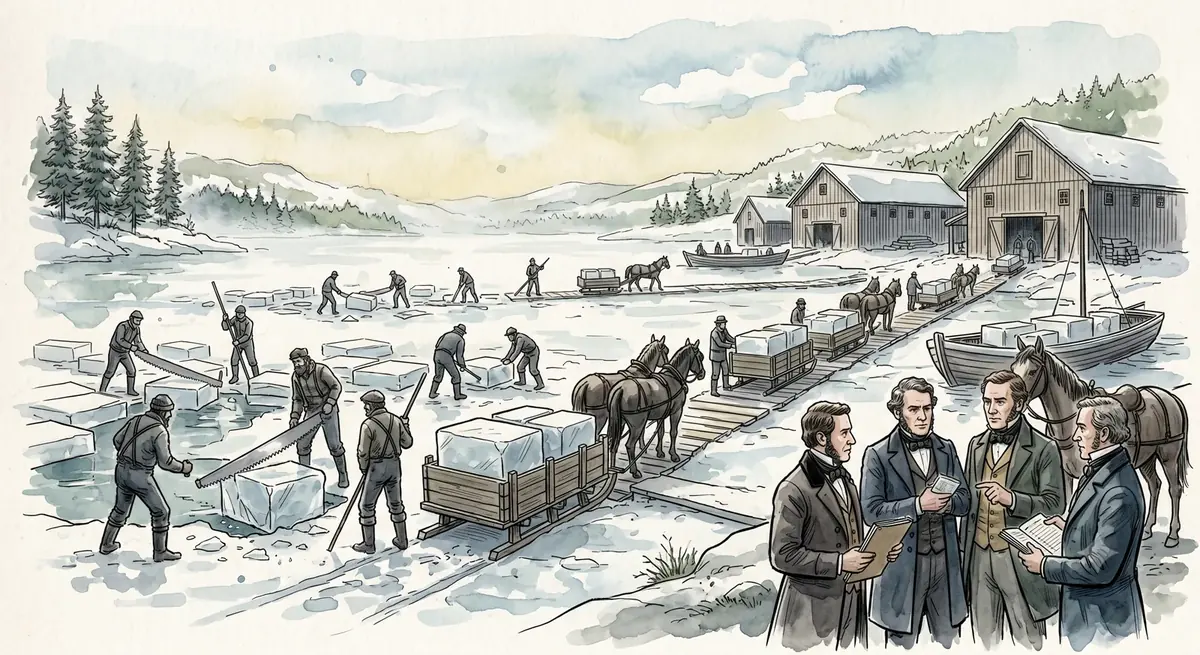
The Harvest
A winter morning in New England
The 19th century knew a market where cold was a product. On winter mornings, crews marched out onto the frozen lakes of New England; those who stood by described the sounds first — the singing of the long saws in the ice, the dry cracking when a block broke loose, the horse-drawn teams on the plank road. The blocks went into warehouses, packed in sawdust, and from there out into the world.
The most successful man in this market was Frederic Tudor. History remembers him as the Ice King: a Boston merchant who hit upon the idea of shipping frozen lake water across the equator (a business idea that was brilliant exactly as long as nobody owned the physics behind it themselves). His ice, as the commercial registers of his time tell it, ultimately reached ports as far away as Calcutta.1 Ice was also harvested at Walden Pond — Henry David Thoreau sat on the shore and watched his pond being cut into blocks and loaded into global trade. The ice from his pond, so the story goes, ended up chilling drinks in ports whose names nobody at the lake could pronounce.
Tudor was not alone. The ice barons of his era competed fiercely — for faster saws, larger warehouses, better routes. They watched each other closely, they knew each other's prices and fleets, they each kept, in their own way, lists of their competitors.
It was a mature, hard, well-measured market — with seasonal prices, insurance for lost cargo, and a profession that knew what it was doing. None of the people on the list killed it. It was killed by the refrigeration machine — a technology layer beneath the market. This raises a question that this record must answer later: Why, as far as history records, did none of these men ever build the machine themselves that ultimately finished them all off?
In any case, the threat was on none of their lists, nor was it in their icehouses.
The right calculation
A defense of procurement
Before this record continues, the status quo deserves a defense, because it has earned it. The SaaS centralization of the years 2008 to 2020 was not an act of convenience, it was the right calculation: A provider amortizes their development across a thousand customers, bears operations, updates, and security, and the customer buys for a subscription what would have cost them months to build themselves and a maintenance grave thereafter. “IT like electricity from the socket” was the saying back then — and the comparison held, as long as the electricity stayed in the socket. Whoever decided to buy instead of make in those years decided correctly.
I know this calculation from the inside. For years, buy was also the default answer at my own workbench: better to work around the limits of someone else's API and buy a dependency than to build it myself — because building it myself was the more expensive mistake. Or so the theory went. Since the model generations of 2025, the same pendulum has swung toward make for me, on one project after another: The threshold for doing it yourself has dropped, the flexibility outweighs the convenience of purchasing. That is empirical evidence from my own practice — marked as such, with no claim to being a market report — and a kind of scar distributed across many small decisions rather than one large one. One exception, however, has always stopped the pendulum: Where someone is supposed to answer for something working — infrastructure, responsibility, the worst-case scenario — I continue to buy.
The calculation back then was correct. Exactly one item from it has survived, and it is not the one the industry puts on the invoice.
The Fracture
The layer underneath
What has shifted sits one floor lower than the competition.
The hyperscalers have stopped delivering only tools to end customers. They deliver capabilities to their agents — building blocks, permissions, configuration power, everything machine-readable and machine-operable. The moment Microsoft and Google empower the customer to generate their own software — because their agent can configure SharePoint entirely (a task on which entire consulting careers used to mature), because they can modify what they need using the operating system — the specialized service that used to charge licensing fees for exactly that becomes a transit station. The platform tools become the deputy's workshop: The agent sets up shop there and builds what their client needs.
The same fracture becomes visible on the surface where it was least expected: the UI. Interfaces can be generated on demand, tailored to the single user and the single task — UI sovereignty, the last moat between provider and customer, falls with it.
For the record, the finding is sufficient: The fracture runs beneath the products, right where only infrastructure used to lie. What grows through it needs a name — and a point of comparison that shows how such a thing ends.
The Machine
Winter on demand
In the 1870s, a Munich engineer built a device that generated cold instead of storing it (out of ammonia, pressure, and Bavarian engineering stubbornness: winter on demand). From this device on, shipping blocks lost its purpose. What was shipped from then on was the capability to generate cold — to wherever it was needed, in any quantity, at any time.
The industry faces the same machine today, and it earns its name: Meta-Software — software whose delivery is the capability to generate code, database queries, and interfaces from intent, rules, and memory on demand; the finished program is merely its imprint. The special application for every purpose is replaced by an apparatus that produces special applications as soon as a purpose arises. However, this apparatus only becomes reliable with a layer of tests, directives, and design rules underneath it — without them, it remains a lottery; how this layer is created is described in “The Constitution of Software”.2
The final objection regularly raised at this point is: “None of this affects us much, we don't have an API.” It is raised unjustly. An agent that finds no interface will, if necessary, operate the human surface itself: It reads the screen, clicks the dialogs, fills out the forms. That is slow, expensive, and fragile — and it gets faster, cheaper, and more stable with every model generation. No interface is a wall. Some are just longer paths.3
Every wall still standing here is actually a tollbooth.
The Mechanics of Overlooking
The Klarna Incident
This answers the question about the frozen lake. The ice barons didn't build the machine because their grid couldn't show it: competitive observation is the observation of those who sell the same thing. Whoever sells the same thing is in the report. Whoever makes selling itself obsolete is in the engine room — one floor down, outside every column of the document.4
That is exactly the Niche Fallacy of the present: the reassurance feeds on the comparison with the direct competitor, who is just as incapable as you are. The comparison is correct — and reassures unjustly, because meanwhile all four old moats are becoming porous at the same time. The complexity of the product shrinks to generability. Domain expertise increasingly resides in the context of the customer agent, who knows the domain firsthand (they sit right in it, after all). The customer relationship now also belongs to whoever talks to the customer daily — and that is increasingly their own deputy. And reach was an argument as long as distribution was expensive.
The Klarna incident. In August 2024, the company stated on an investor call that they had shut down Salesforce and would have Workday follow in a few weeks — they were consolidating a number of SaaS providers. The leaked recording went viral. In early 2025, the CEO clarified: not a language model replacing SaaS, but consolidation of many providers plus a custom-built internal stack.5 Anyone who reads an all-clear in this clarification is reading it wrong. Precisely the sober version is the finding: A customer who can consolidate and build it themselves has switched sides, from buyer to producer with a purchasing option. For their previous vendor, this alters the basis of business, regardless of how many licenses continue to run for the time being.
The finding is therefore not murder among colleagues. The finding is a side entry from below. What remains to be clarified is what remains standing after the entry — above as well as below.
Refrigerator and Cold Chain
The bipolar geometry
Below: your own cold factory. The refrigerator turned every household into a cold producer, and Self-Software repeats this movement: The customer with an agent builds what they used to buy — their own dashboard, their own workflow, their own analysis; by reconfiguring what their platform layer already provides anyway, entirely without classic programming. The dark sides belong in the finding: homemade builds rot away, nobody patches them, and when something breaks, there is no vendor to call. No one sues their own refrigerator.
Above: the guarded chain. There are domains where “the agent crashed” is a sentence with legal or existential consequences: payroll, the diagnostic system, accounting, the chain that must not break. Purchasing continues there, and more resolutely than ever — only what is bought there is not on any feature list.
The line. Its measure is neither company size nor sector: it follows the consequence asymmetry of failure, measured per use case instead of per company. The same house operates the marketing dashboard in-house and buys the guarded payroll system; the same household chills its lemonade in its own appliance and obtains its insulin via the certified chain. Go through your product list and ask, per function, what a mistake costs the customer — where the answer hurts, that is where your line runs. Warm lemonade is an annoyance; warm insulin is a lawsuit.
The line doesn't run between companies — it runs right through every company. And above it stands the question this market has gone longest without asking: What is actually being sold up there?
What the Iceman Sold
Back to the lake, one last time into the books of the ice trade — because something is written there that wasn't obvious at first glance.
What did the iceman ever sell? Ice, the invoice says. The invoice is misleading. The block in the sawdust was a carrier material. What was paid for was the promise behind it: that the milk wouldn't sour tomorrow, that the fish would survive the summer, that the storage would hold. In 1900, you bought this promise from a professional. Today, the refrigerator owner produces it themselves, without ever thinking about it again. And the pharmaceutical chain buys it to this day — with a signature, with a protocol, with a name on the contract.
Three stations, one commodity that never appeared on the invoice.
What are your customers really buying from you — and did you know it yourself?
The Buyer of Last Resort
The last sellable commodity
The answer begins with a question I asked myself at my own workbench: What am I actually selling? Companies believe they are selling software or a service. Trust? Not always. Rather, reliability — and the need for trust or liability in case something doesn't work reliably.
There is a name for this, and it only comes up now because it only holds weight now: Outsourcing of Liability — the outsourcing of liability. The surviving product has two floors. On the bottom is reliability as an apparatus: tests, monitoring, escalation chains, everything that actually reduces the occurrence of damage. On top is the liability itself — the addressee when the chain breaks anyway. The CIO who buys a guarded payroll system buys both floors, and they buy the top floor more consciously than the industry wants to admit: the vendor you can call and yell at, the counterpart who has to explain the incident — to them, to the board, in court if necessary. It is the same psychology that ensures no one changes their tax advisor over a single glitch — but everyone does over an advisor who lets the phone ring during an audit. The cold chain has sold nothing else for a hundred years: the promise that the chain will hold, and someone to answer for it when something thaws anyway.6
As a business model, the upper floor is called Managed Agent Ecosystem: The operator sells results instead of tools — the customer provides the intent, the operator bears the execution risk and gets paid precisely for bearing it. How an operator measures this risk in advance before signing off on it is a discipline in itself. Only the sorting needs to be noted here: What Meta-Software leaves over is exactly this item — the only one the customer cannot generate themselves.
The Risk Absorber
Insurance jargon
If that is true, the category redefines itself. “Software company” will mean: a company that absorbs risk — and valuation, pricing, and self-image will follow suit. What will be priced in the future is the assumed damage potential instead of the seat per month; what will be evaluated is the resilience of the bearer instead of the speed of their roadmap. No one asks the reinsurer about their vision. The industry is thus switching from licensing logic to insurance logic, and that brings its own gravity: Liability scales with the balance sheet, not with code. The hope that the new market will become more fragmented and open thus has a built-in limit — only those who carry the weight can answer for it. Anyone entering the market anew will therefore look for use cases whose risk can still be borne with a narrow balance sheet, and will climb the risk ladder as their balance sheet grows.
And whoever is liable inevitably collects: An operator who answers for results must know what “done” means and where their client's red lines lie; they therefore keep the protocols, the approvals, the precedents. Whoever bears liability accumulates data sovereignty.7
A shift of this magnitude does not stay in the balance sheets. The commercial rationale for employing entry-level professionals was always also liability absorption: someone with proxy power and experience answered for the work that a beginner grew into. If liability is redistributed, this rationale moves with it — where it goes is shown in “The Book of Hours”, the series finale on the industry's training chain.
Until then, the final question of this record remains open, and it is more uncomfortable than any market forecast: Whoever bears liability accumulates the files — and under whose jurisdiction do they fall? And who actually still works in this company then?
Thaw
The final image belongs to the warehouse: sawdust, meltwater, the long saws on the wall — the need for which all this was built has never disappeared. It is just met differently today. Frederic Tudor, according to all records, saw the thaw of his market coming exactly like all the other barons: not at all. Yet his records of the competitors' fleets, warehouses, and routes were kept correctly right to the end. They were never wrong. It was just the wrong document being correctly updated. Go ahead and put your own analysis back on the table — and next to it, the customer list.
The ice barons did not die because someone cut better ice. They died because cold stopped being a product. Software is currently stopping being one.
What won't stop: the need for someone to answer for it when things thaw.
- Of roughly 180 tons loaded in Boston in 1833, about 100 reached Calcutta. That was considered a success.
- As the manuscript preceding this series puts it: “We will no longer buy apps, but subscribe to results. The proxy agent replaces the interface. When LLMs write database queries and generate user interfaces on demand, niche software dies. This is the end of rigid, complex software and the beginning of custom-tailored tools for every problem – instantly generated, perfectly adapted.” (Michael Überschär, AI Fundamentals, Chap. 12: Day_After_Tomorrow)
- The ice barons would have disagreed. For a while.
- Competitive analysis, noun: a document that records all threats except the one you die from.
- On an investor call in August 2024, Klarna CEO Sebastian Siemiatkowski said: “We just shut down Salesforce. Within a few weeks, we will shut down Workday. We are shutting down a lot of our SaaS providers, as we are able to consolidate.” The leaked recording went viral via Seeking Alpha. In March 2025, he clarified in an X-thread: “So no, we did not replace SaaS with an LLM” — Klarna had consolidated many, not all, SaaS providers and built an internal stack (including Neo4j) that brings together the data scattered across the systems. Not to be confused with the separate Klarna incident regarding AI customer service — that is a different story with a different moral.
- The same manuscript calls this the shift to an economy of responsibility: “We are shifting from an economy of creation to an economy of responsibility. In a reality where generating text, code, and strategy is virtually free, the value shifts radically: from the craft of making to the burden of deciding. The work doesn't disappear; it condenses into the risky moment of approval. We are becoming a society of final consumers who are liable for results they no longer produced themselves and – in the case of the black box of complex systems – often can no longer fully comprehend in detail.” (Michael Überschär, AI Fundamentals, Chap. 12: Day_After_Tomorrow)
- Previously, the entity keeping files on us was called a platform. In the future, it will be called a risk bearer and will speak insurance jargon. The files remain the same.